
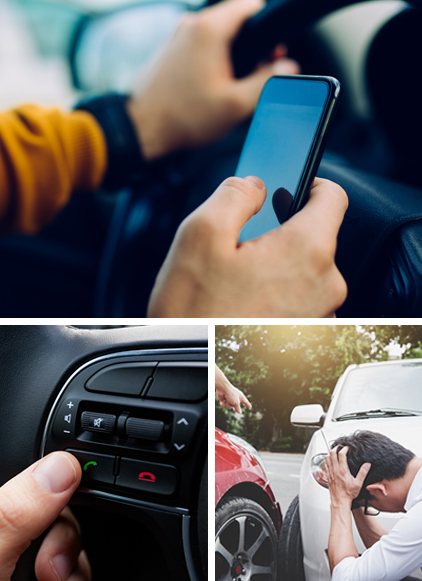
Distracted driving is any activity that diverts attention from driving, including talking or texting on your phone, eating and drinking, talking to people in your vehicle, fiddling with the stereo, entertainment or navigation system - anything that takes your attention away from the task of safe driving.
Rhode Island law prohibits mobile electronic device use while driving without hands free capability. Additionally, minor drivers are restricted from using any mobile electronic device while driving – with or without hands free capability.
Distracted driving caused by use of personal electronic devices is a growing problem, leading to needless deaths and serious injuries. Rhode Island has a hands-free law for drivers, and we recommend drivers avoid any distracting activities when behind the wheel and focus their attention on the road ahead.
Across the country, distracted driving claimed 2,841 lives in 2018 alone. This included 1,730 drivers, 605 passengers, 400 pedestrians and 77 bicyclists who lost their lives. Plus, an estimated 400,000 people were injured in crashes involving distracted drivers in 2018.
Texting is the most alarming distraction. Sending or reading a text takes your eyes off the road for five seconds. At 55 mph, that's like driving the length of an entire football field with your eyes closed. Those texting and driving are 23 times more likely to get into a crash - much higher odds than those driving while impaired by alcohol.
Drivers age 16-24 have been distracted by devices at higher rates than other drivers. Female drivers are the most at-risk for fatal crashes involving distracted drivers, but we’re all at risk, and you can make a difference.
RIDOT and its safety partners were pleased to help play a role in the passage of a hand’s free law in June 2018. Previously, Rhode Island had a law that only prohibited texting while driving. Drivers cannot hold a cell phone or other wireless device while operating a vehicle. The use of headphones or other accessories that cover both ears also is not allowed.
Under the hands-free law, drivers can use an in-car or other hands-free systems or accessories, commonly using a wireless technology called Bluetooth. The law is not only in effect while the car is in motion, but also when stopped at red lights or stop signs. If a police officer observes you holding a phone and talking or texting while driving, you will be pulled over and may be fined up to $100. Learn more about the hands-free law here.
Aside from hands-free technology, many cell phones and cell phone providers provide options for disabling the phone while you are driving, sending a message to anyone who may be calling or texting you that you are driving right now and will get back them when you reach your destination.
For minor drivers, they are restricted from using any mobile electronic device while driving – with or without hands-free capability.
April is Distracted Driving month, when we focus public outreach efforts on this problem. We also take part in NHTSA's national effort called "U Drive. U Text. U Pay." During this time, law enforcement will be looking for distracted drivers and issuing fines.
Consider these tips for safe driving: